What is coffee roasting, actually? Nearly every culinary process that transforms raw ingredients—whether baking, grilling, roasting, or braising, relies on the strategic transfer of heat. Typically, this involves an intermediary agent: water for boiling, fats for frying, or air for baking. Other methods, such as grilling, rely fundamentally on direct contact with a high-temperature surface.
In coffee roasting, the choice between an intermediary agent and direct contact is not as straightforward. After all, any cooking technique that involves heat application does so in the service of great taste. When it comes to roasting, it boils down to a choice between convection (agent) and conduction (contact).
To clarify the difference between conduction and convection, imagine a juicy, pre-marinated piece of meat lying on a hot cast iron plate. This type of cooking method utilizes conduction. Now, imagine the same piece of meat suspended inside an oven and treated with hot air. That would be convection. Which one stirs your juices?
Conduction vs. Convection in Coffee Roasting
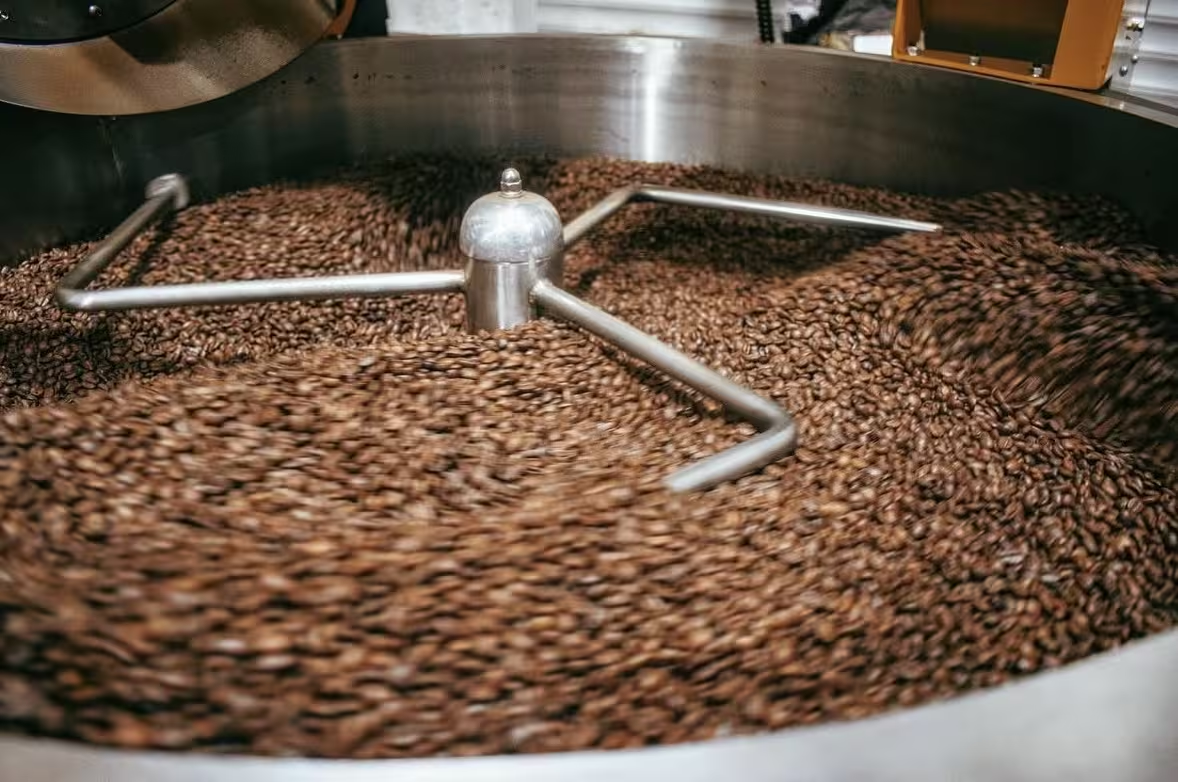
The analogy carries through to coffee roasting. Roasting using conduction means the beans are coming into contact with a hot metal surface—the surface of the drum where the roasting takes place. Roasting using convection means that heat is applied indirectly using hot air. To stress the same point, Instaurator recently posted an article in Espressology titled “Are You Roasting or Baking?” To put it in a nutshell: if your coffee roaster can bake a pound cake for you, it isn’t really roasting your beans.
In the early days of barrel-over-flame configurations, hot air was used to remove smoke, chaff, and excess moisture. Later, it was adopted as a heat transfer mechanism, since it guaranteed consistent results with fewer side effects in a shorter amount of time. But then again, attempting to avoid tipping and scorching at all costs ends up taking the essence out of coffee roasting and the flavor out of the roasted beans.
Roasting can only truly occur within a narrow heat range before the beans start charring. Hitting that sweet spot results in a full-bodied, sophisticated aromatic profile. The best way to get there is through a complex fusion of heat conduction and thermal radiation, using the least amount of air possible.
Given the right thermodynamic system, a good coffee-roasting machine can deliver heat through contact—metal surface onto bean surface—without using hot air blasts or gadgetry. Once consistency is maintained and side effects are under control, one can truly reap the reward: a harvest of heavenly flavors.